
Republic of Georgia
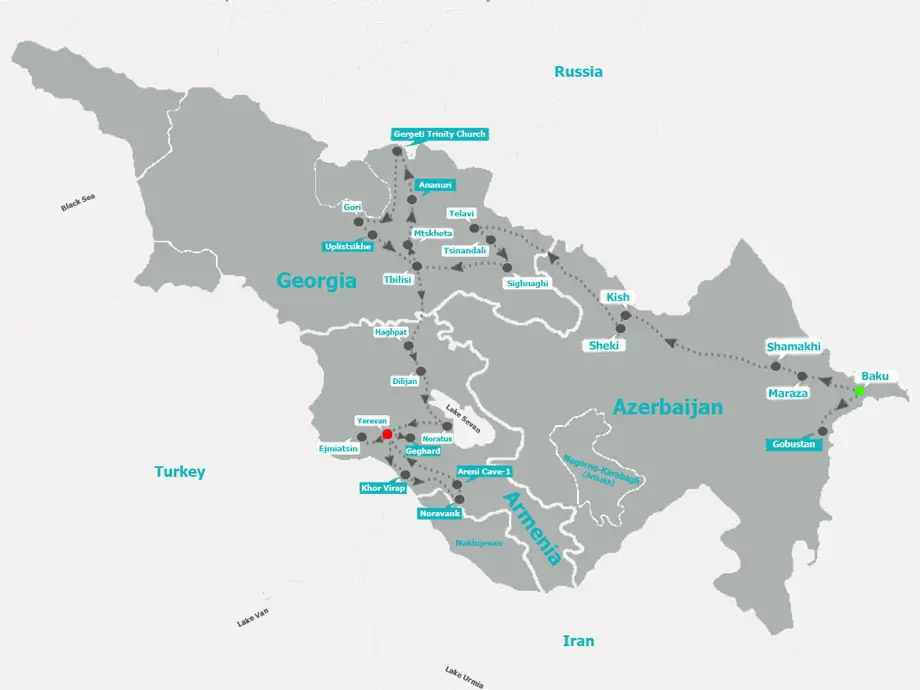
We met Zezva, our great guide for Georgia, and Garik, our driver, after crossing the Azerbaijan border and passing customs and passport control.
Recommendations
- Khareba Winery
- Tsinandali Estate
- Sighnaghi
- Bodbe Monastery
- Metekhi Church
- Narikala Fortress
- Rike Park
- Bridge of Peace
- Shavteli Street
- Rezo Gabriadze Puppet Theater and Tower
- Anchiskhati Basilica
- Sioni Street
- Sioni Cathedral
- Meidan Market
- Anunuri Fortress
- Kazbegi
- Gergeti Holy Trinity Church
We drove to a small local restaurant and winery, the Chateau Re-Vazis Marani. We learned about the ancient wine culture in Georgia, including 538 varieties of grapes and the 1000s of blends available. We tried several wines before lunch, a white, rose, and red, then were served an excellent meal, family style. Beef, pork, delicious vegetables, salads, and breads, with more wine.


We had time to visit their vineyards and a small garden. What an absolutely wonderful welcome to Georgia.
After lunch we drove through endless vineyards in the beautiful Kakheti region, saw lines and lines of trucks delivering grapes to various wineries because it’s harvest season, and continued to the Khareba Winery.

More wine tasting! We visited part of the tunnel, 7.7 km long, that was built in the 1950s as part of a military facility, and their “wine cave”. The cave was opened in 1962 for the World Congress of Vine and Wine. Temperatures range from 12-16 C, ideal for wine storage and aging. They have over 26,000 bottles stored in their tunnel.
We listened to their musicians while waiting for our guide. She told us some of the history of the site, we heard about the 8000 year old “qvevri” or wine storage bottle found in Georgia, then tried three of their wines in the open part of the tunnel, with small bites of bread and cheese. The building and grounds are beautiful.
Khareba Winery


We spent the night in Winery and Hotel ARGE, just outside Telavi. It was quite a distance from the city, but had incredible grounds to explore, lots of outbuildings, and I had a huge corner room with balcony. Loved it.
I tried two traditional Georgian dishes at their restaurant, their chicken soup, chikhirtma, and dumplings, khinkali. The chicken in the soup was a bone-in thigh, so I removed to a plate, cut off the meat and returned to the bowl. The broth, with cream and eggs, and lots of herbs, is delicious. The Georgian dumplings, khinkali, are filled with meat, fish, or vegetables and spices. I ordered the chicken. They were priced individually so tried ordering two, no, minimum of five. Too many. A stray dog enjoyed my leftovers.
I later learned that khinkali are “traditionally eaten by hand, using the tough ‘tail’ at the top (k’udi or k’uch’i), while the pleated top is not eaten.” Cutting them with knife and fork was difficult as they are quite moist and fell apart. I left the ‘tail’ regardless. I didn’t find them very tasty and didn’t try them again while in Georgia.
The next morning we left for Tsinandali after a late breakfast. We stopped in Telavi, briefly, to see their “giant plane tree” and the statue of King Ereckle II, before visiting the Tsinandali Estate. Maggie, from the UK, and Bjorn, from Norway, joined our tour today.
Tsinandali is the house and gardens of 19th c poet and aristocrat, Alexander Chavchavadze (1786-1846). He inherited the land from his father, Prince Garsevan, then refurbished the land and build the new Italian style palace and a decorative garden. It is now a hotel, winery, and multiple restaurants. We visited the old estate building, with its lovely rooms, the wine cellar, and tried some their wine. It’s Georgia! More wine!

There were no photos allowed but one woman had joined the tour late and maybe didn’t hear that message. She took quite a few. I ran into her in the afternoon at the monastery and asked her to send me those photos, giving her my Portuguese number so she sent them via WhatsApp. Accessory after the fact? Well, maybe. But I didn’t take them.
We learned a little about the Georgian language and alphabet, also. There have been three major changes to the letters over the centuries. The first recorded Georgian alphabet is from the 1st c, one from the 7th, and the one they currently use is from the 11th c, with just minor changes. We saw all three on a sign at the hotel.

Second row, 1st c.
Third row, 7th c.


We visited Sighnaghi, an absolutely lovely, lovely town. We did a short walk together, seeing the WWI memorial and city square, having some free time to enjoy the views before going to lunch.
Lunch was another very touristy place, huge groups, bad service, average food at best. They were so busy, Zezva told us to order then go for a walk, so I, and several others, walked along the old city walls to the city gate. There are 23 towers along the walls. There were beautiful views from the walls though so glad to have this opportunity. Definitely could have spent a few hours here.


We stopped at Bodbe Monastery dedicated to Saint Nino (Nina). Nino was an evangelist who brought Christianity to Georgia. She is buried in the Church of Saint George, the oldest structure within the convent, from the 4th c.
The large church is the Cathedral of Saint Nina, just completed in 2019. Most of the church is empty and unadorned with a lot of work still going on. The Church of Saint Tamar the Confessor and The Church of Saint Gabriel the Fool-for-Christ and Confessor, down the hill from the Cathedral, were both built between 2023 and 2025. There is also a three-story bell tower at the Bodbe Convent completed in 1885. The grounds are lovely, with many roses. There are about 30 nuns living on the site.


We stayed at the Tbilisi Ramada by Wyndham in Old Town, for 3 nights. Since our lunch was around 1600 I just picked up a few beers down the street and had an early night.
The next morning we had a walking tour of Tbilisi.

We started at the statue of Vakhtang Gorgasali, the founder of Tbilisi, with an excellent view of the old city and Kura River. We visited Metekhi Church on the large square. While at the square, we heard more information about Old Town and about the Mothers of Georgia Statue on the hill. We saw the Narikala Fortress on the way down. It’s on the hill overlooking Old Town, two main walled sections are all that is left, along with the restored Saint Nicholas church.

We walked down the hill and made a short stop in Rike Park, where the cable car starts, and saw the great Tree of Life statue, too. We crossed the river over the pedestrian Bridge of Peace to Gorgasali Square. Walking down the pedestrian, cobblestone Shavteli Street, we enjoyed the sites and lots of art and restaurants and different architecture.
We passed the Patriarch of Georgia and discussed the Georgian Orthodox Church as well as the relationships between the various Orthodox churches of Europe. We also stopped at several places to look at the city crest, on manhole covers and bollards, with a falcon and pheasant.

We saw the noon show at the Rezo Gabriadze Puppet Theater and Tower. What a lovely tower, crooked and “held up” by a support beam; it looks like something you’d see in a movie. There are two puppet displays on the tower, above the clock displays every hour, the small “theater” below the clock only at noon every day. The tower also has the smallest working clock in the city, embedded in the base of the tower.
We visited the beautiful Anchiskhati Basilica and saw the Orthodox priest blessing a couple. We continued to see Sioni Street and Sioni Cathedral, and the sulfur baths. ‘Tbil’ means warm in Georgian, ‘isi’ is an ancient word for water, so Tbilisi is warm water.
The tour ended at the baths and several people took cable cars to the hill, several went back to the hotel. I joined a few others for lunch at Restaurant Pasanauri on Gorgasali Street and had a absurdly large Greek Salad that I ate about a third. Fresh and delicious, though, and huge pieces of feta. The food that everyone ordered looked excellent, and they had a good selection on the menu.


The power went out in this part of town before we all paid, by then Zezva had returned from calling taxis and Bolts and helped the restaurant staff total up costs manually. Fortunately, everyone had Georgian Lari to pay. Odette, Olivia, and I were going back to Meidan Market. We had walked through the market earlier on the tour but because the power was out the gates were pulled shut and all the staff were sitting on on the stairs. We ended up returning to the hotel as well. We were going to take the cable cars after shopping. I’m very glad we weren’t on them when the power went out, I looked up and there were 3 cars unmoving overhead.

I had a beer over in the restaurant at the hotel and enjoyed seeing their hanging candles and trying the local Black Lion beer before meeting the group for our dinner.
That evening we met in the lobby to walk over to In the Shadow of Metekhi, for a traditional dinner show. We had a huge selection of excellent food, lots of choices, great vegetables, eggplant and beets and tomatoes and cucumbers, the cheese bread, chicken, pork, different wine plus great dancing and music.

The next day we checked out of the hotel. We were going to drive to Kazbegi. On the drive we stopped at the Hofbrau Munchen Gudauri. They did have one plate of German food, a “sausage plate” but mostly it was a Georgian menu. I had a really good khachapuri adjarruli, the cheese bread with egg, a cucumber, tomato salad, and a HB beer, of course.
Our first stop of the day was the amazing Ananuri Complex, two churches, a watchtower and defensive walls on Zhinvali Reservoir. It dates from the 16th-17th c and was a residence for the Dukes of Aragvi. We started with great views of the complex from the new bridge, then went inside the walls. I visited both the large Church of the Assumption and the small Church of St. George. The tower and walls were added later to protect against invaders. The road, dam, and reservoir are all new since the castle was built so it was much more secure than it currently looks, with everyone having to approach up the hill. I also climbed the narrow inner walls for a great view of the courtyard.


 We drove along the Georgian Military Highway. This is major route through the Caucasus from Georgia to Russia. It runs for 212 kilometers between Tbilisi and Vladikavkaz, Russia. It follows the same route used by both invaders and traders for centuries.
We stopped at the Russian-Georgia Friendship Monument, built in 1983. It is a large concrete memorial with tile and quotes from the Georgian epic poem, “The Knight in the Panther’s Skin”, 12th c, by Shota Rustaveli. Zezva says the Russians used this poem because they knew how important Rustaveli is to the Georgians and they didn’t like the memorial. It’s actually attractive with all the tile but even better is the location with views across the valleys and mountains, the highest point in the mountains is over 2300 meters at the Jvari Pass just a few kilometers away.


Our next stop was the amazing Gergeti Holy Trinity Church, from the 14th c, located at an altitude of 2170 meters on the slopes of Mount Kazbek. Mount Kazbek is the seventh highest peak in the Caucasus.
The church is gorgeous with breathtaking views. The church was built with local materials, stone and wood, and has beautiful frescoes, and an icon of St. Nino(a), patron saint of Georgia. There are wild horses on the hills, too.


We stayed overnight at the Sunshine Hotel in Kazbegi. A very nice hotel, comfortable room, breakfast served family style.
I joined Odette and Olivia and Colin and Kylie for dinner at Green Sheep. We had to navigate past cows on the road on the walk down to the restaurant.
The next morning, I went out to get photos of Gergeti Church on the deck out back. The church was hidden in the clouds, then barely visible, then hidden, then I got a few great photos. One is the featured photo for this post.
The cows must have stayed out late because I also got to see the cows coming home the next morning from my room which faced the road.
The next day, we headed back to Tbilisi with stops at Mtskheta, Georgia’s old capital city. Mtskheta is considered the religious center of Georgia. We visited the Jvari Cathedral on the hill overlooking the conjunction of Mtkvari and Aragvi rivers and the old city. The cathedral is from the 6th c, Georgian Orthodox and is a UNESCO Heritage Site. The church was built on the site where Saint Nino and the first Christian Georgian King Mirian erected a large cross. The base of the original cross is in the center of the church, and the cathedral is also called the Mtskheta Church of the Holy Cross.


We visited the Svetitskhoveli Cathedral next, the main cathedral of Mtskheta. It is considered a sacred place where the robe of Christ is kept. The church and the grounds are huge. We had a short tour of the inside with Zezva then had free time to enjoy both the inside and the grounds. We had lunch nearby at Tsiskvili.


In the evening we returned to Tbilisi. We stayed at the Gino Seaside Hotel, also a Wyndam hotel, instead of the Ramada Wyndam in Old Town. Despite the name, it is not on the sea, but is on the Tbilisi Reservoir. I had a great room with huge balcony overlooking the reservoir and enjoyed the beautiful sunrise the next morning.
That evening I went to Old Town with Olivia and Odette to go shopping and visit the cable cars. I was surprised that Zezva arranged transportation for us, those extras are usually not included. We went to the Meidan Market and did some shopping then walked to Rike Park to take the cable cars to the hill. We visited Mothers of Georgia, did some more shopping, and enjoyed the views before returning to the park. Tbilisi is gorgeous all lit up, the Bridge of Peace, the statue of Vakhtang Gorgasali, and Metekhi Church. We took a Bolt back to the hotel.

Restaurants
- Chateau Re-Vazis Marani
- In the Shadow of Metekhi, Tbilisi
- Tsiskvili, Mtskheta
- Restaurant Pasanauri, Tbilisi
- Hofbrau Munich Gudauri
- Green Sheep, Kazbegi


*** All photos property of Lisa, not to be copied or reproduced without permission ***


In the Shadow of Metekhi dinner show
In the Shadow of Metekhi dinner show
Kazbegi
Ananuri Fortress Walls
View of Metekhi, the Old Capital from Jvari Monastery