
Armenia
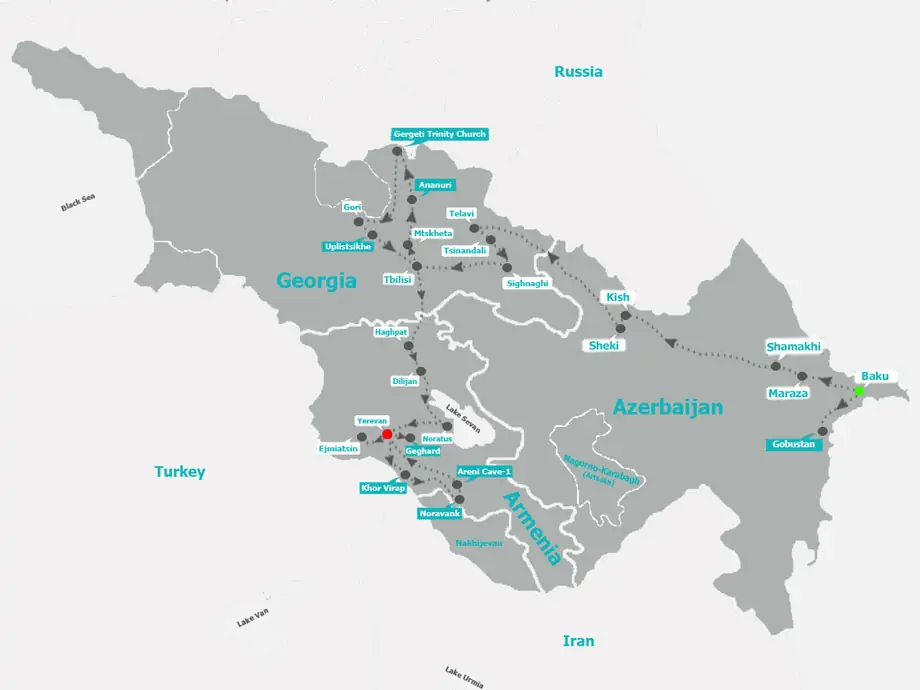
After saying goodbye to Zezva, Colin, Kylie, and Bjorn in Tbilisi, Garik drove us to the Armenian border. We were able to leave our bags on the van this time but had to walk through passport control. Garik and our new guide, Manya, met us after we all went through immigration.
There was a big market, or welcome center, on the border so many of us also changed money or used the ATM. I had verified the exchange rate, over 400 Armenian Dram to 1€. But I foolishly misread the ATM, “max 500”, thought that’s odd (strike one, should have known that couldn’t be just 500 dram and stopped), but tried 500 (insufficient funds, strike two) then 150 and got 150 THOUSAND dram. Over 350 euros. Way more than I would need for 5 days. I ended up selling about 70000 to others on the tour who needed cash over the next several days, paid cash for everything, and still had enough for tips; better than using a money exchange to get euros back.
Recommendations
- Haghpat Monastery
- Sanahin Monastery
- Old Dilijan Complex
- Goshavank Monastery
- Hayravank Monastery
- Lake Sevan
- Noratus Cemetery
- Lake Sevan
- Yerevan, Republic Square and Abovyan Street
- Geghard Monastery
- Symphony of Stones
- Garni Temple
- Khor Virap
- Noravank Monastery
- Areni-1 Cave
- Etchmiadzin Cathedral
- Saint Hripsime
- Zvarnots
- History Museum of Armenia
- Vernissage Flea Market
Our first stop in Armenia was the lovely Haghpat Monastery. It’s a UNESCO World Heritage site from the 12th c. There is a main church building with multiple outbuildings. When we saw the library, we all guessed the use of the room incorrectly based on the holes in the floor. We learned these held clay jars that stored the manuscripts, protecting them from both vandals and damage. We were told that the monks from here traveled to the library of Alexandria to copy those books into Armenian. When the library in Alexandria was damaged in a fire, they came to Armenia to copy the books back into Arabic. The original off-site backups? The featured photo for this post is Haghpat from on the hill above the site.


We also visited the Sanahin Monastery. Manya told us most Armenian Apostolic churches are undecorated and dark, they should be just you and God. This monastery was an educational center, like many monasteries of Armenia in the Middle Ages. There is a library and study halls for the monks along with the monastery. There are also multiple churches on site, including Saint Astvatsatsin (Holy Mother of God), Saint Amenaprkich (Redeemer), and Saint Grigor.
Both monasteries were built during the Kiurikian dynasty, from the 10th to 13th c.


We drove through the Tavush region to Dilijan. Locals call this area “Little Switzerland”, for its forests and hills. We visited the Old Dilijan Complex. This site, located on Sharambeyan Street, is one of the oldest streets in Dilijan. It is from the 19th c and has the best-preserved examples of local architecture of the region. There are beautiful two-story houses with red-tile roofs and wooden balconies with intricate carvings. We had some free time in the downtown area and everyone picked up some souvenirs or food.

We stayed in the Hotel Arevi Gosh that evening. When we arrived power was out for the area but, fortunately, came back on within half an hour or so and we were all able to enjoy our rooms and some relaxing time in their courtyard. I had picked up a few drinks in Dilijan and they let me put them in their refrigerator along with my morning Pepsi. Sometimes I wish I liked coffee, it’s certainly easier to get in most cases.
The next morning we visited the Goshavank Monastery just a few minutes from our hotel. There is an 800 year old Armenian cross here. The symbols around the cross are all different but all represent infinity. There are many beautiful crosses here, inside the buildings and outside from ruins. There is a large statue of the founder, Mkhitar Gosh, outside the church.
After leaving the monastery we drove along the large and beautiful Lake Sevan. We had great views of the lake throughout our drive. Lake Sevan is 1,900 meters above sea level and is one of the world’s largest freshwater high-altitude lakes.
We stopped at the Hayravnak Monastery, a 9th c Armenian apostolic church. More stunning stone buildings, I loved the carved wooden main door, and we had beautiful views of the lake from here.


We had an excellent lunch in Tsovazard village at the Hovane family. We were offered a huge selection of food in their lovely home. Fish from Sevan Lake, a great carrot salad, eggplant and tomatoes, roast potatoes, lavash bread, and much more, including trying their homemade vodka.
We visited the amazing Noratus Cemetery on the drive to Yerevan. It’s a medieval cemetery with more khachkars, or Armenian cross stones, than anywhere in Armenia. When I was looking up dates for Noratus, I read that there used to be a larger collection of the stones in the Jufla cemetery that was in the Nakhchivan exclave of Azerbaijan but it was destroyed by the Azerbaijan government.
The basic design of a khachkar is a simple cross carved into a plain stone background, but there are thousands of different designs and many are very intricate. There is no “typical” khachkar but many have botanical designs, like grapes, pomegranates, and vines, to symbolize new life and resurrection.

The oldest khachkars in the cemetery date back to the late 10th century.


‘There is a legend about the cemetery that in the 19th-century a monk named Ter Karapet Hovhanesi-Hovakimyan, from a monastery near the village, conducted burial services at Noratus. He had a 2 hour walk to and from the cemetery to the monastery, so he built a small cell in Noratus. When he was 90 years old, he asked his brother monks to bury him alive.
His last words were: “I do not fear death. I would like you to not be afraid as well. Never fear anything, but God alone. Let anyone who has fear come to me. Pour water at the burial stone, drink the water, wash your face, chest, arms, and legs. Then break the vessel that contained the water. Fear will then abandon you.” To this day people come to the monk’s grave to perform this ritual, leaving broken pieces of glass scattered all about. We saw several people performing this ritual while visiting the cemetery.’ Manya told us about the priest while we were there watching the ceremony and I found these details on Wikipedia.
Ritual at Noratus
We spent the next four nights at the Felinger Hotel in Yerevan. It was nice to not have to pack up every day. It was a bit of a walk from many of the sites but a comfortable room. Breakfast was on the 9th floor with great views of the city and Mount Ararat.
Odette, Olivia, and I walked downtown to Republic Square that evening. It was beautiful all lit up. We also visited a great market and all bought some t-shirts and other souvenirs before stopping for desert and drinks at Abovyan-12, recommended by Manya.
We had a walking tour of Yerevan the next morning. We stopped by to pick up Maggie, Edith, and Helen, who were at another hotel. They all booked the trip quite late and so Cascade couldn’t get them into Felinger.

We visited the Cascade Monument. It was originally designed in the 1920s by the architect Alexander Tamanyan, to link the city center with the northern hills. It was started in the 80s, but remained only partially complete for over a decade due to high costs and the collapse of the USSR. In 2002, a foundation took it over to complete the project. The Cascade leads into a park with dozens of statues including a huge statue of Tamanyan leaning over a table, supposedly contemplating his design of Yerevan. There is a water fountain nearby where you can lean over and recreate this scene.
I really liked the lion made from old recycled tires. We visited Abovyan Street, saw the huge Opera House, walked down Northern Avenue, the pedestrian street, saw the Walking Man statue there, visited Republic Square, Komitas Park, and more.


We were picked up by Garik and taken to Geghard Monastery, another beautiful UNESCO Heritage Site. Geghard means “Holy Spear”. The church is amazing, with many crosses and other tombstones throughout the complex, and churches dug from the huge cliff. We visited the dome, it has perfect acoustics and there were four singers here. There is a hole in the dome that allows you to look down into the church (or up into the dome from the church). There is also a holy spring that we all lined up to drink from.
Singers at Geghard Monastery


We visited the gorgeous Symphony of Stones, located in the Garni Gorge. It is a natural rock formation of basalt columns, millions of years old, also known as the “Basalt Organ” because it looks like a huge pipe organ. It was created through the crystallization of volcanic lava. It reminded me of Devil’s Tower in Wyoming or the Giants Causeway in Ireland (although I’ve only seen pictures of that site).


We could see Garni Temple on the hill above the gorge and we visited there after leaving the Symphony of Stones. It was built around 77 CE under King Tiridates I; a Greek inscription found in 1945 names him. An earthquake in the 17th c destroyed the temple and it wasn’t reconstructed until around 1970. There is also a ruin of an old fortress from the 3rd c BCE. There was a musician in the temple playing the traditional duduk or woodwind instrument. Garni is dedicated to Mihr, the Armenian god of the sun.

We had stopped midday at a small family bakery for a quick lunch and saw the ladies making lavash bread in the stone ovens.
The next morning we drove to Khor Virap Monastery. Khor Virap means “deep dungeon”. It was where Saint Gregory, “The Illuminator”, was imprisoned for 13 years by King Tiridates III before being released and becoming his mentor and helping to spread Christianity in the 3rd c. The 7 meter well, in one of the outer buildings, the prison, can be visited but it’s a very small room and there was a long, slow-moving line to enter the stairwell to his cell.
On the hilltop behind the monastery are the ruins of Artashat, the capital of ancient Armenia in the 2nd century BCE. I climbed up the hill for great views of the monastery complex.

The monastery is only a few kilometers from the Turkish border and Mount Ararat. We could see the road and border but, unfortunately, it was cloudy enough that we did not have good views of the mountain. The photos online of the mountain and monastery are beautiful, really wish we had had clear skies.
The main church, Saint Astvatsatsin (Holy Mother of God), is from the 17th c. On the back of the church is a wall of names carved into the stones of people who escaped from Turkiye in 1918-1920 during the genocide.


We continued to the Noravank Monastery, set on high red cliffs. The monastery is from the 13th c and was an educational center, the monks here copied religious texts and created illustrated books. The monastery was also a residence of the Orbelian princes, one of the most influential families in medieval Armenia. There are some amazing carvings in the church.

The large church, another church named Saint Astvatsatsin (Holy Mother of God) or Burtelashen (“Built by Prince Burtel”), is two stories. There are stairs, narrow and steep, no visitor access allowed, on the outside of the church, leading to the second floor. We also learned here about the narrow stairs inside the churches. We’ve been seeing those at all the monasteries. They lead to small dark rooms where individuals can go confess their sins to God, it is not required of the Armenian Apostolic adherents to confess to a priest.

The church has wall engravings showing the Virgin Mary, Apostles Peter and Paul, Jesus Christ, the archangels Gabriel and Michael, with floral and geometric patterns.
The complex also includes the church of Saint Karepet, the 13th c Saint Stephen church, Saint Gevorg tomb, 18th-century chapels, and dozens of khachkars.


We had lunch at the nearby Siranes restaurant, I had some excellent grilled chicken and grilled vegetables.
Our last stop of the day was the archeology site, Areni-1 Cave. The cave is still a working dig but they close for several months to allow tourist visits. The world’s oldest shoe was found in 2008, by Armenian Ph.D student, Diana Zardaryan. The shoe is displayed in the history museum in Yerevan. In 2011, the the oldest winery in the world, with a wine press, clay pots, and vine seeds were excavated in the cave, proving Armenia’s winemaking traditions. In 2009, a human brain was discovered and in 2011, a straw skirt dating to 3900 BCE was reported. There are guards in the cave to prevent any damage or vandalism from visitors.


We stopped at the Hin Areni, or Old Areni, vineyard and winery; it’s considered the oldest winery in the world. We had a guide to tell us a little of the history of the area, the grapes, the history of the winemaking, and then tried 3 of their wines. They were all very good. Returning to Yerevan, many of us chose to get dropped off by Republic Square and I went with Odette and Olivia to Vernissage Flea Market. We had about an hour before they closed.


Manya had rearranged our original itinerary slightly to give us more free time our last day, allowing shopping or other activities. We started the final day with a visit to Saint Hripsime Church, or “Temple of the Holy Witness of Christ”. Gregory the Illuminator built a hermitage where Saint Hripsime was martyred. It was destroyed during the Armenian-Iranian war in the 4th c then rebuilt later that century by Isaac the Great, or Sahak Parthev, leader of the Armenian church. He was a direct descendant of Saint Gregory.


After leaving Hripsime we visited the huge complex of the Holy Etchmiadzin Cathedral in the town of Vaghatshapat, just outside Yerevan. The former name of the town was Ejmiatsin, sometimes spelled as Echmiadzin or Etchmiadzin, and the cathedral is known by the old name. It is considered the spiritual center for all Armenians.
The cathedral was built in 301 CE and is considered the world’s first Christian church. It was expanded in the 7th, 17th, and 19th c. There is a large separate building for baptisms, with a beautiful silver font. There is also a library, a science building and a new large entry gate and courtyard area where Pope John Paul II gave a prayer visit in 2001.
The museum of relics, entry at the back of the church, is only 2000 AMD, or about 5€. No photos were allowed in the church but they were allowed in the museum. There were many beautiful objects and relics.


Our final visit of the day was one of my favorite sites in Armenia, Zvarnots Cathedral. It is another UNESCO Heritage Site. It was an ancient pagan temple dedicated to Tir. During excavations, a Urartian temple was found, an sacrificial altar and an inscription to King Rusa II, After Armenia adopted Christianity, it became a Christian church. It was built in the 7th c, to last 1000 years, or until Christ returned, but was destroyed around the 10th c. Archeologists believe it was destroyed by an earthquake. It originally had three levels, we saw a model in the small museum on site.


Back in Yerevan, many on the bus were dropped off at a farmer’s market. I asked to get dropped off near Republic Square so I could go to History Museum of Armenia. I spent several hours in this excellent museum. It’s been open since 1921 and has over 400,000 items from prehistoric times to present.
“The museum’s permanent exhibition presents the history and culture of the Armenian people from the Stone Age to the present day. However, at the moment, permanent exhibition halls representing the period from the Stone Age to the Middle Ages are available. The exhibition is structured in chronological order and each gallery has a title corresponding to its content. They are:
- In the footsteps of the ancient man. Stone age
- Through reality and myths. Bronze age
- Iron Age
- The Kingdom of the Gods. Urartu/Bianili
- Strength and beauty. Ancient Armenia
- Christian Armenia”
After leaving the museum I walked back over to Vernissage Flea Market since I only had about an hour here the day before and didn’t visit most of the stalls. I picked up several gifts for family for Christmas.
Armenia is a lovely country with some beautiful sites. I’m very glad to have had this short visit.
Restaurants
- Siranes Refectory at Noravank Monastery
- Abovyan 12


Khor Virap – looking into Turkiye and Mount Ararat, hidden in clouds


